
The UP Diliman (UPD) Office of the Vice Chancellor for Research and Development and the UPD Research, Extension, and Professional Staff (REPS) Welfare Council recently held the SULONG REPS Colloquium 2025.
With the theme Advancing Knowledge, Empowering Communities: Research, Extension, and Professional Staff Contributions to the 20230 Sustainable Development Goals, the colloquium highlighted UPD REPS’ essential role in advancing and promoting the United Nation’s 2030 Sustainable Development Goals (SDGs). The event also aspired to motivate the UPD REPS to continue their work in promoting knowledge through collaboration, innovation, and academic service.
UPD Chancellor Edgardo Carlo L. Vistan II in his welcome remarks underscored the REPS’ vital role in achieving the University’s goal of academic excellence and transformative leadership through research, professional service, and extension initiatives. He also commended the REPS’ role as catalysts for inclusive growth, sustainability, and social justice in addition to being knowledge producers.
“Your efforts, whether in the lab, in the field, in our offices, or in our classrooms, are deeply interwoven with the aspirations of the 2030 Sustainable Development Goals. You are helping build a university that is not only excellent but also compassionate, responsive, and relevant,” said Vistan.
Meanwhile, UP Vice President for Research and Innovation Joel Joseph S. Marciano, in his keynote address, commended the REPS for their valuable contributions to UP’s goal of becoming a research university. He emphasized that REPS are vital part of an ecosystem that merges research and innovation, urging them to always think about innovation ahead of time.

“Innovations means inventions, new ideas, new product services, and creative works that is appreciated, that enlightens, that motivates, that deepens our knowledge, and advances or make the society progress. That is our mission,” Marciano said.
He then encouraged the REPS to be like a sponge. Marciano likened the absorptive capacity of sponges to one’s lifelong learning but reminded attendees that learning alone is not enough — knowledge should be applied. “Give back what we have learned, pay forward. You know your place, you know where you are, and you’re always ready when call upon to serve,” Marciano explained.
The colloquium featured plenary lectures from the REPS Chairs awardees from the three REPS clusters. The award is a recognition given to highest performing REPS with salary grade 18 and above.
Joy Ann P. Santos, PhD, university researcher at the Biological Research and Services Laboratory of the Natural Sciences Research Institute, talked on the pathogen surveillance using diagnostic kits for food safety and security.
Pepito T. Dizon, university extension specialist at the National Engineering Center, and program development associate for organizational culture and productivity at the Office of the Vice President for Administration, discussed the Completed Staff Work (CSW), a structured training program based on in-depth problem analysis. CSW, which has trained more than 1,800 individuals, advances a rigorous and accountable culture in the workplace.
Elvira B. Lapuz, a university librarian and senior lecturer at the School of Library and Information Studies, presented a study describing libraries as driving forces for inclusivity and sustainability. Through digitization initiatives, construction of solar-powered facilities, and the provision for student-wellness space; libraries, rather than just merely knowledge repositories, play a vital role in achieving the SDG goals.
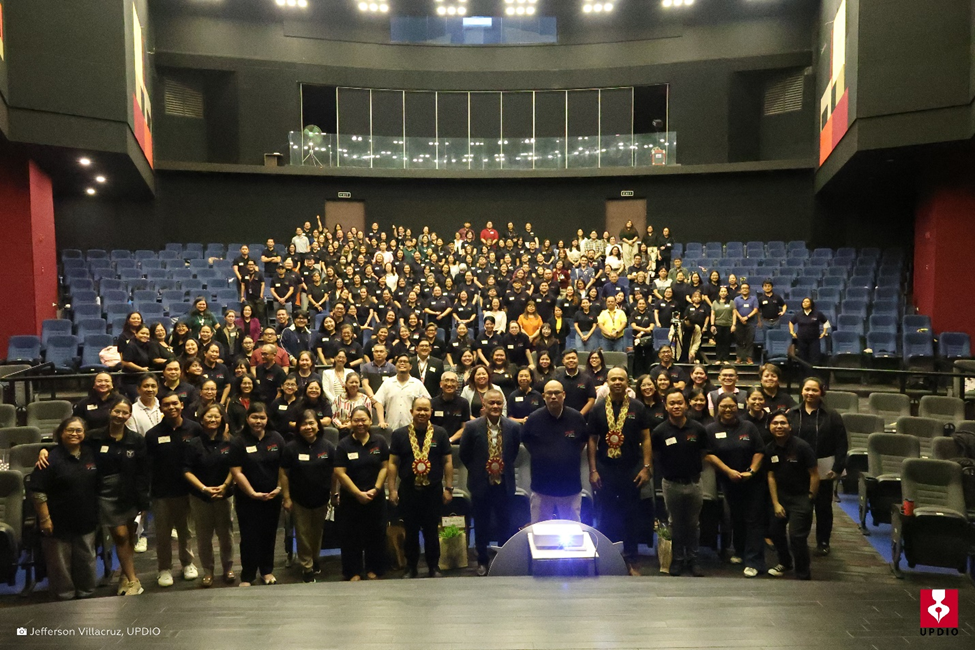
The event also showcased three parallel sessions which carried themes on SDGs.
The first session demonstrated how inclusive growth is fueled by the intersections of science, entrepreneurship, education, and culture. The second session emphasized the interconnection of institutional practices, scientific innovation, and community participation with sustainability and resilience; while the third session featured how community involvement, research, and education promote sustainability, equity, and well-being.
The colloquium included poster presentations of the dynamic and diverse contributions of the UPD REPS — from improving service delivery and providing transformative training, to breaking new grounds in research and broadening institutional outreach. The poster presentation also highlighted the REPS’ observations and insights from the conferences and seminars they participated in.
Attended by close to 300 UPD REPS, the colloquium was held on Nov. 7 at the Benito Sy-Pow Auditorium, College of Architecture.