
The presentation highlighted how contemporary theater-makers from the Global South increasingly emphasized caring performance in theater to confront social and political issues, giving a voice to marginalized communities.
Sir Anril P. Tiatco, PhD, explained, “This collection of performance works represents some of the most vital political and experimental trends in global contemporary theater. While they span different continents, languages, and aesthetic styles, they are united by a common urge: deconstructing dominant narratives, whether canonical Western literature, hidden colonial labor, or wartime atrocities, and rewriting them through the physical bodies and lived testimonies of marginalized communities.”
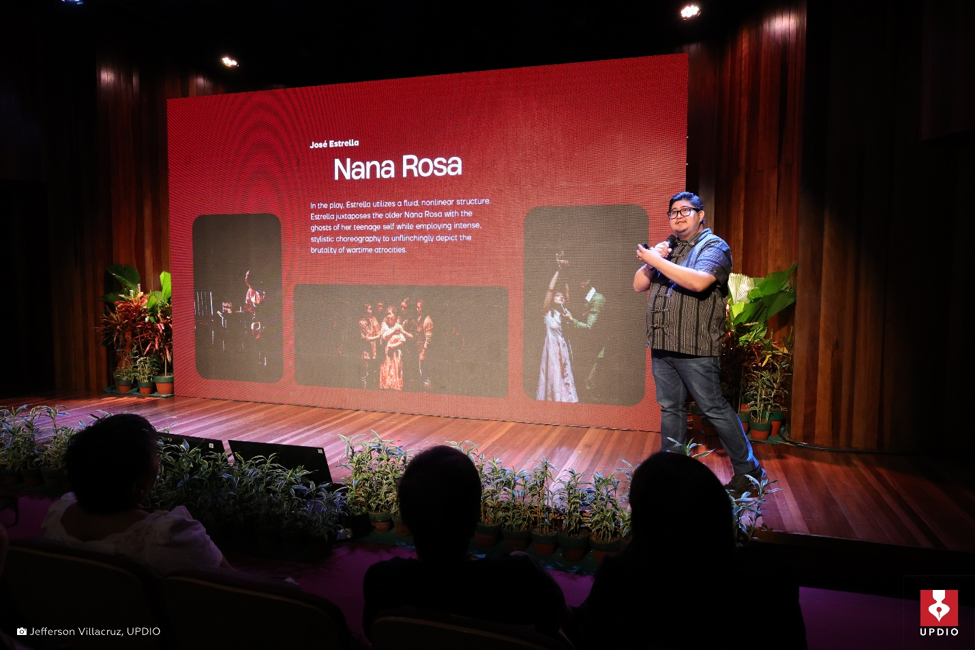
He explained the selected theater-makers from the Global South shared common historical and political experiences. “Global South” is presented not as a geographical category but as a concept linking communities with a shared history of colonialism and political struggles, including experiences under dictatorial regimes.
These remarks were part of Tiatco’s preliminary overview of the research project Contemporary Theatre-Makers: Politics and Engagement, Community and Innovation at the Liwanagan sa Diliman: Illuminating Filipino Experiences Through Research (Liwanagan).
Tiatco, a professor at the UP Diliman (UPD) Department of Speech Communication and Theatre Arts, College of Arts and Letters (CAL), drew his presentation from fieldwork conducted across Southeast Asian festival circuits. Tiatco said he engaged theatre-makers from the Global South, including Lola Arias of Argentina, Chela de Ferrari of Peru, Ugoran Prasad of Indonesia, Faustin Linyekula of Congo, Caroline Nguyen of Vietnam, and Josefina Estrella of the Philippines.
He said contemporary is not used as a temporal label but as a way of describing theatre-makers who resist established conventions and traditional classifications. Inspired by contemporary dance, the term reflects their experimental approach, breaking away from traditional constraints and rigid rules, and giving emphasis on expressing emotion through the body and performance.
He explained Arias creates a safe space for survivors of sexual abuse, while de Ferrari promotes inclusion by featuring performers with Down syndrome. Linyekula, Nguyen, and Estrella similarly use theater to address political repression, exploitation, and the experiences of wartime sexual violence, turning the stage into a space for testimony, reflection, and social awareness. Tiatco said he did not include Prasad’s work in his presentation because the latter’s latest production is yet to premiere and remained under confidentiality during their fieldwork.
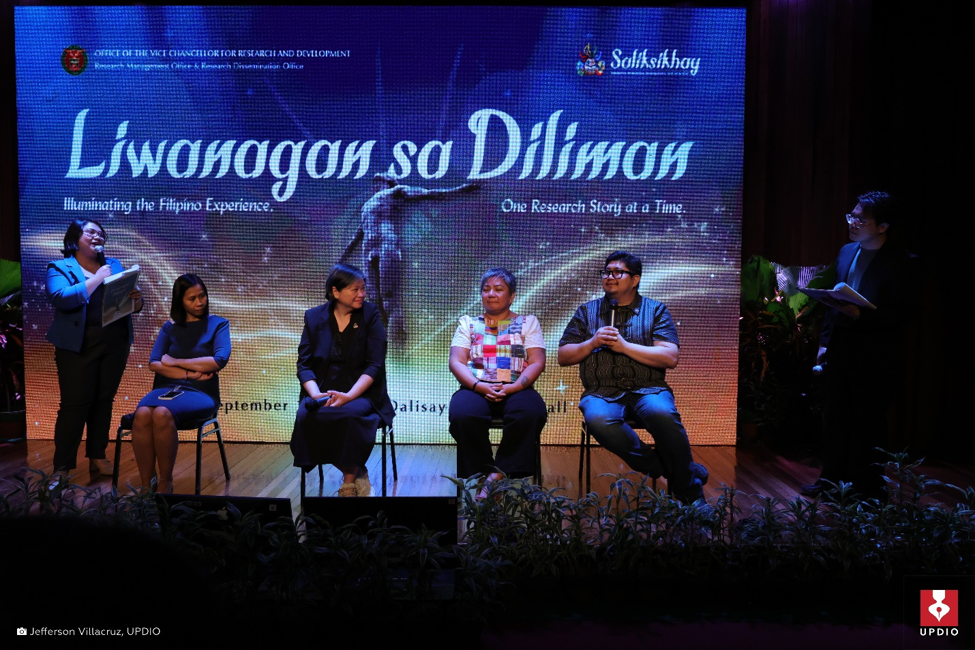
Tiatco concluded his presentation by sharing an insight from an interview with Estrella on why theater-making remains important today.
Quoting Estrella, he said “kailangang magpatuloy ito, umiiral ito dahil theater has the potential to show what the world could be, despite what it is.”
Fourteen other research works, including that of Kristyl N. Obispado, PhD of the Department of History; Christine V. Lao, PhD of the Department of English and Comparative Literature; and Roselle V. Pineda, PhD of the Department of Art Studies were presented at the Liwanagan, held from Sept. 16 to 17 at the Aldaba Rehearsal Hall of the UP Theater.