
Bino C. Gamba and Mariamme D. Jadloc
Mathematicians and scholars convened at the Congruence & Convergence, an international conference to honor former UP Diliman (UPD) Chancellor Fidel R. Nemenzo for his contributions to mathematics, higher education, and the promotion of science and culture in and out of the country.
According to the conference organizer, Nemenzo is “a leading number theorist whose work, particularly in elliptic curves and coding theory, has significantly shaped mathematical research in the Philippines.”
Twenty distinguished international scholars and academicians were featured as plenary lecturers during the three-day event.
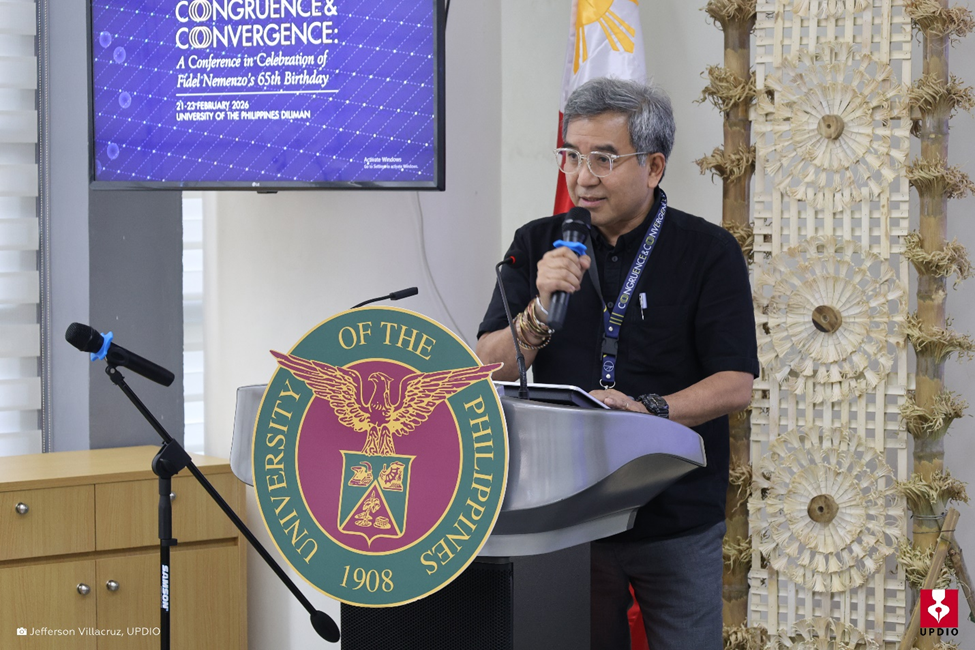
The first day featured seven talks, with Jose Maria P. Balmaceda, PhD; Rowena Alma L. Betty, PhD; Romar dela Cruz, PhD; Louise Antonette N. De Las Peñas, PhD; Saraleen Mae Manongsong, PhD; Francesco Pappalardi, PhD; and Michel Waldschmidt, PhD as lecturers.
Balmaceda, UPD professor emeritus from the UPD Institute of Mathematics (IM) presented When Minds Align, When Passions Converge. He was followed by Dela Cruz, associate professor at the IM, who shared On Secret Sharing Schemes Over Rings, then by Waldschmidt, emeritus professor at Sorbonne University, Paris, France, who presented On Multicyclotomic Polynomials and Binary Forms.
Betty, professor at IM, came next, with her presentation Classification of Self-orthogonal and Self-dual Codes over Finite Rings. Following her was Pappalardi, professor of Algebra at Roma Tre University, who talked about Imprimitive Points on Elliptic Curves. Manongsong, assistant professor at UP Baguio (UPB), came after him with her talk Exploring Robotics: Algebraic Geometry’s Lens on Constraints Varieties and Kinematic Chains. De Las Peñas, professor at the Ateneo de Manila University Department of Mathematics, ended the Day 1 lectures with her talk On the Analysis of Symmetry Group Structures in Tilings on a Klein Bottle.
The second day also consisted of seven lectures, starting with Koichiro Akiyama, PhD’s Research on Public-Key Cryptography Based on the Solving Problem of Nonlinear Indeterminate Equations.
He was followed by Valerio Talamanca, PhD, who discussed Snapshots from the History of the Mordell Conjecture: From Finiteness to Bounds. Russelle H. Guadalupe, PhD came after him with his lecture Linear Identities for Partition Pairs with 5-cores.
Arlene Pascasio, PhD, professor of Mathematics and University Fellow at De La Salle University, succeeded the lectures with her presentation on Global and Local Symmetry in Distance-Regular Graphs: Insights from the Terwilliger Algebra. Three more lectures followed: Block-Transitive, Point-imprimitive Designs by Carmen Amarra, PhD; Representing and Computing with Algebraic Number Fields by Mark J. Encarnación, Dr. Techn; and Fidel’s Early Friends: Congruent Numbers and Elliptic Curves by Jerome T. Dimabayao, PhD.
Akiyama is information security expert at Toshiba Corporation, Talamanca is president of the Roman Number Theory Association, and Guadalupe is assistant professor at the IM. Meanwhile, Pascasio is professor of Mathematics and University Fellow at De La Salle University, Amarra is associate professor at the IM, Encarnación is director of AI Engineering at Microsoft in Redmond, Washington, and Dimabayao is professor at the IM.
The third and final day of the conference had six lectures, starting with May Debate pa ba Hinggil sa Programang “General Education” ng UP? by Ramon Guillermo, PhD.
Guillermo’s lecture was followed Fidel Nemenzo and the Seedbeds of Philippine Coding and Number Theory by Victor Manuel Aricheta, PhD.
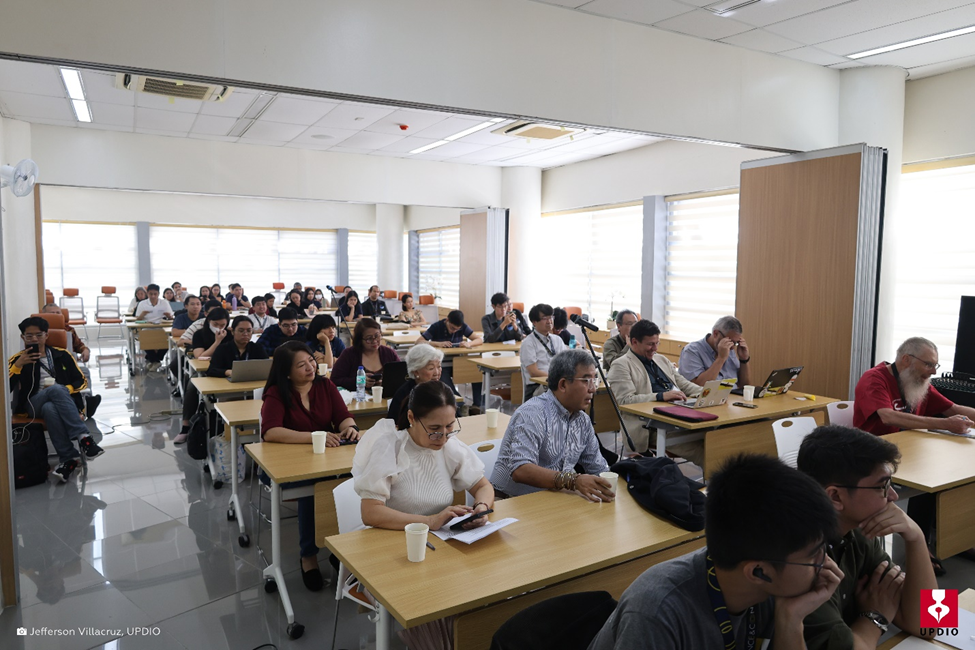
National Scientist Raul V. Fabella, PhD was the third lecturer. His topic was Castration vs. Syndicate Corruption: Overcoming the Free Riding Problem in Collective Action Games from Wisdoms of the Past and of the Future
Math Education, Social Justice, and Fidel Nemenzo: One Battle After Another by Wilfredo V. Alangui, PhD came next.
The Folly of Basic and Applied: Notes on a Crude Binary by Clement C. Camposano, PhD and Convergence and Congruence: Proof, Praxis, and the University as Communities of Scholars by Ma. Cynthia Rose Banzon-Bautista, PhD were the penultimate and ultimate conference lectures, respectively.
Guillermo is the director of the UPD Center for International Studies, and Aricheta is associate professor at the IM. Fabella is also professor emeritus of the UPD School of Economics, while Alangui is professor of Mathematics at UPB. Camposano is UP Visayas chancellor and Banzon-Bautista is a distinguished sociologist and the former UP vice president for academic affairs.
Of the 20 lectures, five directly mentions Nemenzo’s “intellectual journey” and contributions to science and culture.
In his closing message, Nemenzo highlighted the critical necessity to connect theory with practice, urging scholars, activists, and institutions to seek greater congruence and convergence in tackling today’s intricate social issues.
He emphasized that the event was not just an academic activity but a venue for significant conversation across various fields and industries, underscoring the need to link intellectual efforts with real-life challenges, especially amid continuing social, political, and economic crises.
According to Nemenzo, the idea of congruence refers to internal coherence—making sure that one’s values, assessments, and behaviors are in harmony. Convergence, on the other hand, advocates for cooperation among various viewpoints and initiatives. He said both are necessary to strengthen collective responses to pressing issues.
Nemenzo noted consistent conference themes, such as the importance of critical scholarship in nation-building, the necessity for interdisciplinary methods, and the significance of preserving intellectual integrity in the face of political influences. He also acknowledged the differences among participants, but he pointed out or characterize the exchanges as constructive rather than divisive.
“What we call basic research and applied research should not be seen as opposing categories, often they are only different moments in the life cycle of an idea. An idea pursued for its own beauty may later turned out to be indispensable. Utility is sometimes delayed, sometimes unexpected,” said Nemenzo.
He also pointed out the current trend of leaning towards determining excellence via metrics or the place in university rankings. Nemenzo said he is concerned when values of educational institutions and providers of public service is reduced to figures or numbers.
“What metrics cannot capture is often what matters most: the slow development of an idea; the mentoring of a struggling student; the courage to pursue an unfashionable problem; the building of programs that serve the nation rather than the rankings table. Rankings do not measure educational depth, quality of teaching, institutional character, and social responsibility,” explained Nemenzo.
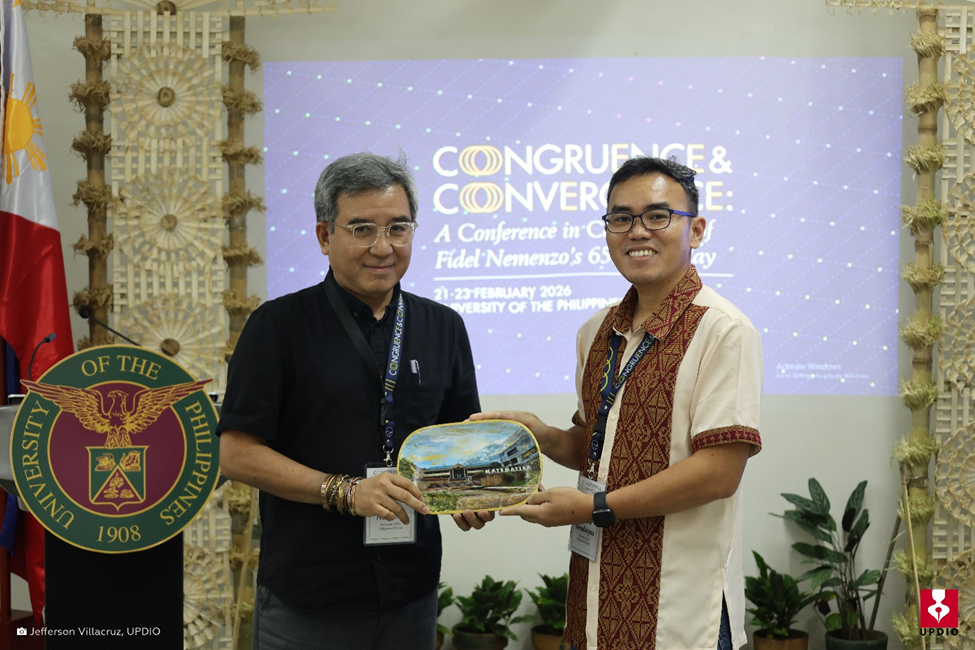
In concluding his message, Nemenzo thanked the participants and encouraged them to carry forward the insights generated during the conference and apply them in their respective fields. He urged them to sustain involvement, persistent discussion, and tangible actions grounded in both analytical reasoning and common objectives, believing that the academic community is well positioned to meet the challenges of achieving a meaningful change that requires both coherence in thought and unity in action.