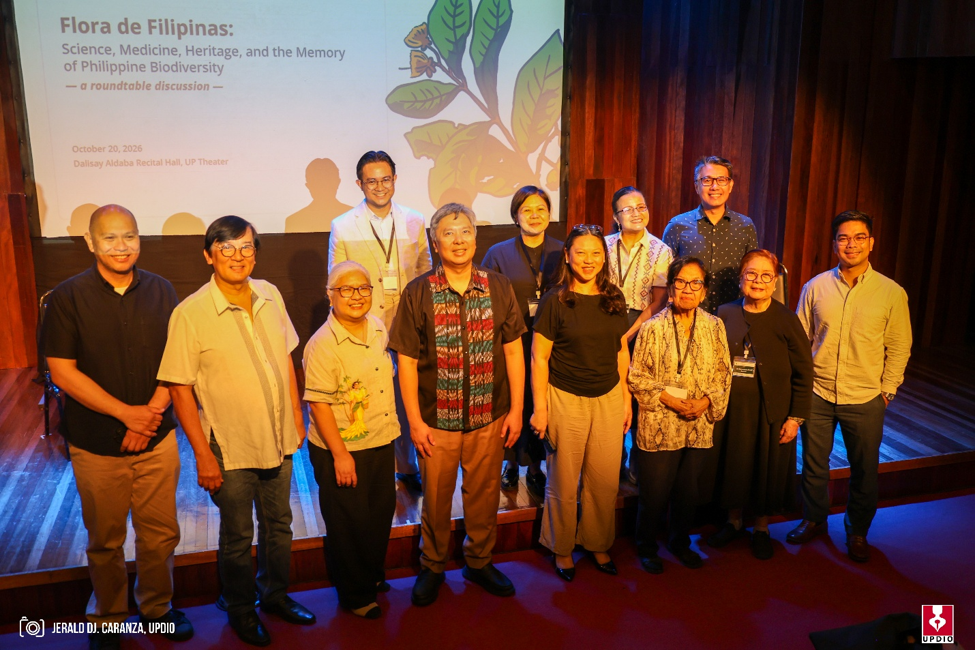
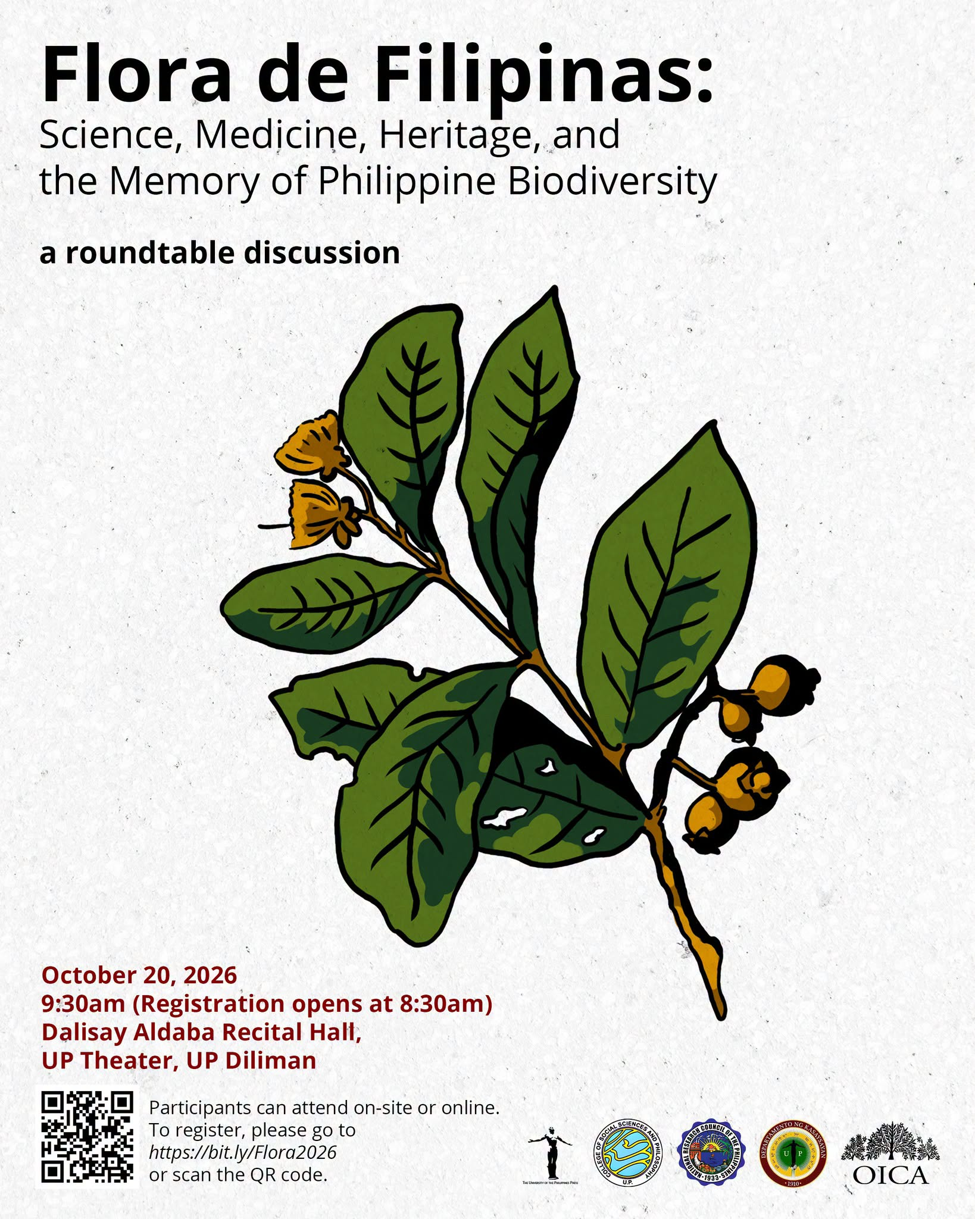
In its bid to have Fray Manuel Blanco’s Flora de Filipinas included in the national and international registers of the UNESCO Memory of the World Programme, the UP Diliman (UPD) Office for Initiatives in Culture and the Arts (OICA), in partnership with the UPD College of Social Sciences and Philosophy (CSSP), UPD Department of History (DHist), Division VIII of the National Research Council of the Philippines (NRCP), and the UP Press, held the roundtable discussion (RTD) Flora de Filipinas: Science, Medicine, Heritage, and the Memory of Philippine Biodiversity at the Aldaba Recital Hall.
According to the UNESCO website on the Memory of the World Programme, its aims are to “facilitate preservation of the world’s documentary heritage, particularly in areas affected by conflict and/or natural disaster; enable universal access to documentary heritage worldwide; and enhance public awareness worldwide of the significance of documentary heritage.”
Prior to this bid, the University was able to inscribe the Jose Maceda Collection, housed at the UP Center for Ethnomusicology, in the International Register of the UNESCO Memory of the World Programme in 2007.
A 19th century botanical encyclopedia, Flora de Filipinas was written by Augustinian friar Manuel Blanco and was first published in 1837.
Maria Mercedes G. Planta, PhD said the book is more than an early botanical publication. Planta spearheads the project to include Flora de Filipinas in the national and international registers of the UNESCO Memory of the World Programme. A DHist professor, she is also section chair of the NRCP Division VIII.
“It is a remarkable record of Philippine biodiversity and of the encounters between European science and Filipino traditions of knowledge, including practices of healing that preceded colonial rule. It is this rich scientific, historical, and cultural legacy that we hope to preserve and bring to wider recognition to the UNESCO Memory of the World Programme,” Planta said.
The RTD’s morning session, Colonial Rule, Missionary Scholarship, and Botanical Knowledge, examined the historical circumstances surrounding the production of Flora de Filipinas.
Emmanuel Jayson V. Bolata, an assistant professor at the UP Diliman (UPD) Department of History, said the session explores “the political and institutional context in which Flora de Filipinas was produced. [It examines] Spanish colonial rule, Augustinian missionary networks, European natural history, and the circulation of botanical knowledge between the Philippines and Europe.”
Discussants for the session were Milagros C. Guerrero, PhD, retired history professor and former DHist chair; Francis M. Navarro, PhD, university archivist at the Ateneo de Manila University; and Corazon S. Alvina, director of the Museo ng Kaalamang Katutubo. Its moderator was Maria Ela L. Atienza, PhD, professor at the UPD Department of Political Science and NRCP Division VIII chair.
DHist Chair Ruel Pagunsan touched on how throughout history, there were people who had huge contributions on published literature but were excluded or written out, much like the ones mentioned by Steven Shapin, a historian of science, in his 1989 seminal essay The Invisible Technicians. Pagunsan said Shapin examined how underground technicians, instrument makers, and skilled manual artisans were written out or excluded in the published literature.
Pagunsan noted that readers of Flora de Filipinas were privileged to have known the author’s local collaborators.
“This invisibility was more prevalent in the colonial context, including in the production of the archipelago’s natural history. In the 18th and 19th century, several Western natural history expeditions and documentations were done, and we see this invisibility among our local guides, interpreters, and even Filipino cultivators who assisted these foreign expeditioners and collectors. But in the Flora de Filipinas, we knew about the local collaborators,” Pagunsan said.
He explained that among the 17 artists and illustrators, 12 were Filipinos, including Regino Garcia Ibaza, chief illustrator and producer of over a hundred plates.
“Through this RTD and succeeding meetings, we hope to spotlight more of the role of the local artisans and knowledge producers,” Pagunsan said.
In his reflection paper, Reading Flora de Filipinas as Historical and Documentary Heritage: Reflections on Colonial Knowledge, Archives, and the Memory of the Philippines,Navarro opined that the book’s importance “lies not only in the plants it describes, but also in the history of how knowledge about those plants was gathered, recorded, organized, and passed on.”
According to Navarro, Flora de Filipinas’ “documentary significance should be demonstrated through careful historical research. We need to explain why this work matters in the Philippines, what it reveals about 19th century natural history, the circulation of knowledge, the meeting of local and European traditions, and the material culture of scientific publication. Equally important is a clear definition of what is being nominated.”
He raised points to consider in seeking the inclusion of Flora de Filipinas to the Memory of the World Programme.
“Are we referring to a particular surviving set, a specific edition, or an identified collection of related documentary materials? Its completeness, authenticity, provenance, condition, ownership, and custodial arrangements must be properly documented. Comparative research into other botanical works and surviving archival sources will strengthen the nomination. Such evidence will also allow us to move from an expression of national pride to a convincing argument for documentary significance of wider importance,” Navarro explained.
He continued that “recognition, should not be the end of the work. It should encourage sustained conversation, responsible digitization, scholarly study, and meaningful public access. A digital image of a botanical plate can reach many readers, but its value is greater when accompanied by accurate descriptions, historical context, and an account of how the image was produced… Our responsibility as students of history, scholars, and custodians of documentary heritage is to read the work with both appreciation and critical care.”
Meanwhile, Guerrero agreed with Navarro’s points and with the points Pagunsan raised.
“Ang mga taong walang mukha, walang tinig, walang masabi, pero sa kanila galing ang lahat. I hope they realize that there is so much heritage in our country that hasn’t been brought into light, and that they have a responsibility to sustain that heritage. Our present has a past. That past has a future,” Guerrero said.
Alvina for her part, said “the book itself has engendered not only knowledge. Someone mentioned the names of the artists… there are two names there that should be familiar to people who like art, Lorenzo Guerrero and Felix Martinez. You have from this book people who flourished in another discipline. They have become artists. Their works are now, of course, the prized things in auctions.”
She underscored the importance of remembering the contributions of the often unnamed or unmentioned people, “the people who were actually using the resources, the organic resources to cure themselves, to nourish themselves.” In addition, the importance of Flora de Filipinas’ registration.
“You have an entire system that can grow out of this registration in the world heritage because such a thing will definitely awaken an interest. I think the other component would actually be communication. The nomination of the document of Friar Blanco to UNESCO memory, whether national or international, will really give way to an understanding and awakening, not only of the Filipino people, but of course of the humanity, of the importance ng ating mga halaman, that it’s really part ng buhay bilang mga tao,” Alvina said.
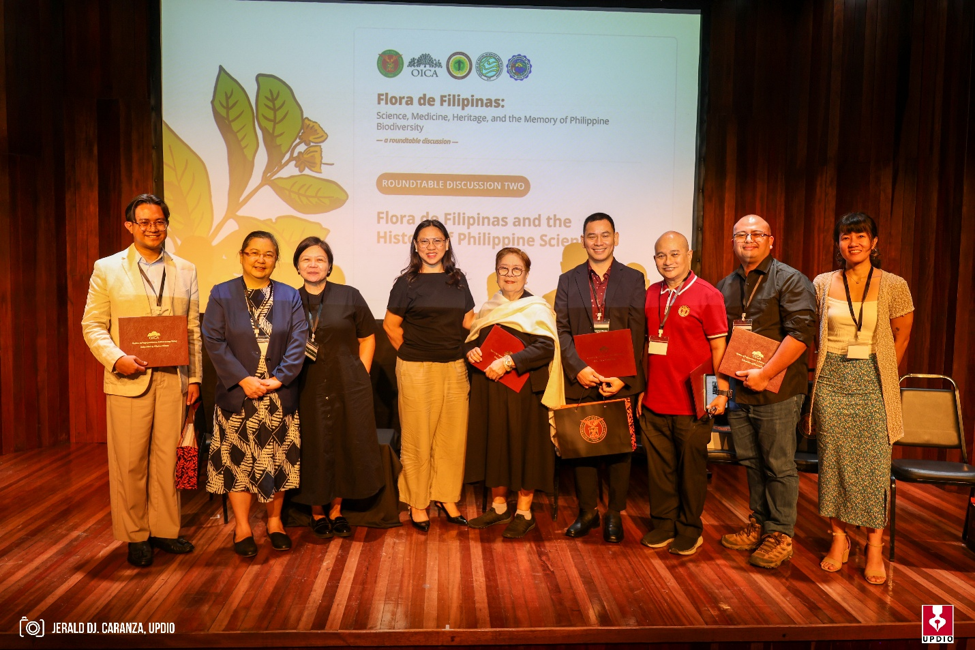
The RTD on Oct. 20 also had an afternoon session, Flora de Filipinas and the History of Philippine Science, which according to Bolata, “considered the book’s contributions to botanical and scientific knowledge and its place in the history of Philippine science.”
The discussants were Alvina; Benjamin M. Vallejo Jr., PhD, professor at the UPD Institute of Environmental Science and Meteorology; Jiro Adorador, assistant professor at the UP Los Baños (UPLB) Institute of Biological Sciences; Marlon P. Rivera, PhD, assistant professor at the UPLB Institute of Biological Sciences Department of Plant Biology; and Celine Murillo, environmental advocate and artist. This had Director Evangeline C. Amor of the UPD Quality Assurance Office as moderator.
The RTD featured messages from UPD Chancellor Edgardo Carlo L. Vistan II, former CSSP Dean Ruth Lusterio-Rico, Chair Nick Deocampo of the Memory of the World Programme Philippines, Planta, and OICA Director Monica Fides Amada W. Santos.
Also in attendance were UP System and UPD officials, including Assistant Vice President for Research and Innovation (Convergence and Translation) Dave D. Centeno and Assistant Vice President for Academic Affairs (Curriculum and Instruction) Ian Kendrich C. Fontanilla.