
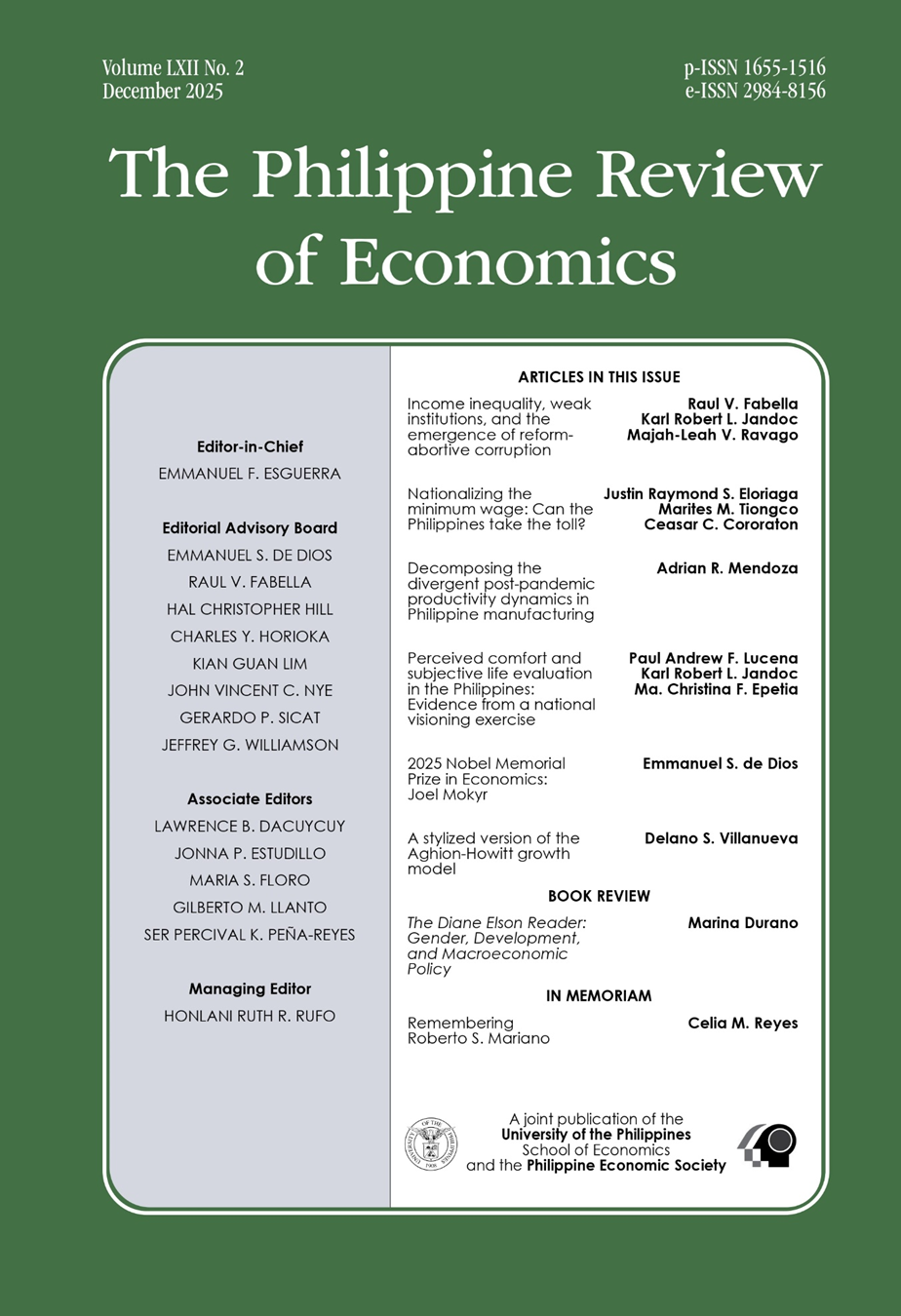
The Philippine Review of Economics (PRE) Volume LXII, No. 2 is now available online.
PRE’s latest issue features six articles, a book review, and an in memoriam.
The articles are Income Inequality, Weak Institutions, and the Emergence of Reform-Abortive Corruption by Raul V. Fabella, Karl Robert L. Jandoc, and Majah Leah V. Ravago; Nationalizing the Minimum Wage: Can the Philippines Take the Toll? by Justine Raymond S. Eloriaga, Marites M. Tiongco, and Caesar C. Cororaton; Decomposing the Divergent Post Pandemic Productivity Dynamics in Philippine Manufacturing by Adrian R. Mendoza; Perceived Comfort and Subjective Life Evaluation in the Philippines: Evidence from a National Visioning Exercise by Paul Andrew F. Lucena, Karl Robert L. Jandoc, and Ma. Christina F. Epetia; 2025 Nobel Memorial Prize in Economics: Joel Mokyr by Emmanuel S. de Dios; and A stylized Version of the Aghion-Howitt Growth Model by Delano S. Villanueva.
Income Inequality, Weak Institutions, and the Emergence of Reform-Abortive Corruption outlines how rent-seeking corruption develops in fragile institutions seized by an elite minority (oligarchs). Driven by income disparity, the elites possess the ability to shape the development and enforcement of laws in their favor.
Nationalizing the Minimum Wage: Can the Philippines Take the Toll? examines the proposed national minimum wage implementation in the Philippines using a regional wage partial computable general equilibrium model to assess four national minimum wage scenarios. The paper strongly warns against significant uniform salary hikes without appropriate improvements in productivity and recommends the necessity for gradual, regional varied modifications combined with supporting measures to standardize employment and enhance productivity.
Decomposing the Divergent Post Pandemic Productivity Dynamics in Philippine Manufacturing analyzes the annual survey of the Philippine business and industry from 2019 to 2022, documenting post-pandemic total factor productivity of the Philippines’ manufacturing sector, especially small and medium enterprises. The study validated the significant yet varied effects of the pandemic on the productivity across sectors and regions.
Perceived Comfort and Subjective Life Evaluation in the Philippines: Evidence from a National Visioning Exercise explores how Filipinos assess their present life situation and identifies the factors linked to attaining a comfortable life, leveraging data from the National Economic and Development Authority’s AmBisyon Natin 2040 visioning exercise.
2025 Nobel Memorial Prize in Economics: Joel Mokyr examines the primary themes in the research works of Joel Mokyr, a co-awardee of the 2025 Sveriges Riksbank Prize in Economic Science in Memory of Alfred Nobel. In the paper’s concluding section, the author expressed possible lessons for developing countries such as the Philippines.
A stylized Version of the Aghion-Howitt Growth Model presents a compact, self-contained 3 x 3 reduced version of the Aghion-Howitt (AH) model (an economic growth model through creative destruction). The paper presents and explains the symbols in the three main equation system of the AH model, described the steady-state or balanced growth conditions, along with the Jacobian for analyzing the local stability. The author declared that developing countries like the Philippines, where research and development sector is expanding, can gain insights from understanding the AH model.
Meanwhile, the book review on The Diane Elson Reader: Gender, Development, and Macroeconomic Policy by Marina Durano addresses the intersecting topics related to gender and the economy, highlighting the issues and challenges of establishing a supportive macroeconomic setting for equitable economic growth that is based on gender fairness.
The In Memoriam by Cecilia Reyes pays tribute to Roberto S. Mariano, a distinguished UP alumnus and professor emeritus of economics at the University of Pennsylvania and Singapore Management University. Mariano also served as editorial board member of the PRE, the Journal of the American Statistical Association, and the International Economic Review, among others.
A peer-reviewed and Scopus-indexed journal, PRE is published biannually by the UP Diliman School of Economics and the Philippine Economic Society.
The latest issue can be accessed at https://pre.econ.upd.edu.ph/index.php/pre.